Route Name: Victorian Trail Swanage
Grade: Easy to Moderate
Print Way Finder Card
DescriptionVICTORIAN TRAIL
Swanage - Durlston - Swanage
Discover the Victorian history of Durlston and Swanage. Walk from Durlston Castle to Swanage Railway Station, or from the station to the castle, through wildlife-rich meadows and cliff-top woodland. 1.5 / 3 hours - 3 miles (4.8km)
George Burt, a Swanage-born businessman, bought land at Durlston in 1862 to develop a grand new estate. He set about improving Swanage, trying to transform it from a town in which “everyone who was not a boatman was a quarrier” into a fashionable seaside resort.
The Victorian Trail is waymarked between Durlston Castle and Swanage railway station - you can follow it in either direction.
Steps
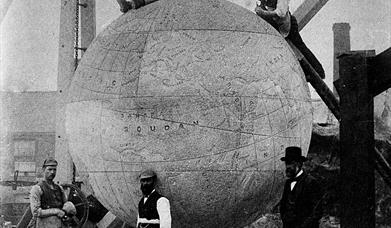
- 1. Burt’s Globe and stone tablets, with their quotations, poetry and instructions for visitors hint at the character of the man ‘in whose nature eccentricity and business capacity, and the instincts of pedagogue, philanthropist and money-maker, seem to have been strangely mixed.
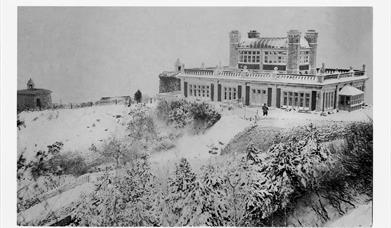
- 2. Burt planned a major residential development at Durlston, with Durlston Castle as its centrepiece.
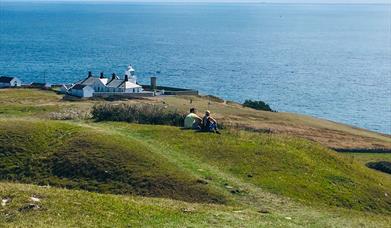
- 3. Gates to your left marks the western boundary to George Burt's Durlston Estate, Burt had grand plans to develop a scenic coastal road to Worth Matravers, so this road would have continued westwards. Today this road continues towards Anvil Point Lighthouse was built by Trinity House in 1881 to give a waypoint for vessels on passage along the English Channel coast and is now has self-catering holiday lets.
- 4. Passing the end of the Learning Centre (public toilets) turn left. Then go through 3 gateways and then turn a sharp right.
- 5. Carry straight on passing quarrying land which was once important employment for the Swanage community. Quarrying still continues today.
- 6. The pathway joins the top of Townsend Road
- 7. Passing the Black Swan on your left and which during the time would have been frequented by Quarrymen after a hard day's work, when sometimes they would have paid using a 'Purbeck Penny' where a stone slab was exchanged as payment for a drink. Ahead and to your right is the Palgrave Cross, behind it down the hill is St Mary's church and Mill Pond follow the road down pass the right of the church.
- 8. Carefully cross the road.
- 10. Railway Station, prior to the railway arriving to Swanage it was very remote place. After a number of years campaigning the first train arrived in 1885. When Burt started a steamer service between Swanage, Poole and Bournemouth in 1871, it became clear that the original pier would be unable to cope with the demands of day trippers and stone boats. Swanage Pier was built, and opened in 1897.
- 11. Take the path to the left of Firswood Guest House and head up the hill to the top to the top and opposite the Purbeck House Hotel.
- 12. Purbeck House was rebuilt by George Burt for his retirement in 1875. Many architectural items displayed at the house were originally from London, a stone arch from Hyde Park Corner, Railings from St Paul's. It is now a Hotel. Built by the same architect and builders as Durlston Castle, Crickmay, William Masters Hardy which are still working today.
- 13. Swanage Town Hall built by George Burt was completed in 1883 at a cost of £4,500 and was originally known as King Alfred Hall. The facade originally came from Mercers Hall in London (originally built in London in 1670 and once the home of the bank of England) and was shipped by Burt to Swanage to create a grand town hall.
- 14. The Square, call into Swanage Museum and Heritage Centre to explore more of the fascinating history of Swanage. From here and beyond you'll glimpse The Grand Hotel across the bay which was built in 1898 and remains as a purpose built hotel today and can be visited for refreshments if you would like to extend your walk (approximately 20 walk minutes from here to Hotel).
- 15. Beyond the square on the right is the Royal Victoria Apartments, originally a manor house, during which time it was stayed in by Princess Victoria in 1833, who was soon to become queen. The building's central facade was rebuilt by William Morton Pitt, to become the Royal Victoria Hotel.
- Head now along the coast path towards Peveril Point the follow the waymarked route back up towards Durlston Country Park

Guide Prices
| Ticket Type | Ticket Tariff |
|---|---|
| Free Admission | Free |
Note: Prices are a guide only and may change on a daily basis.